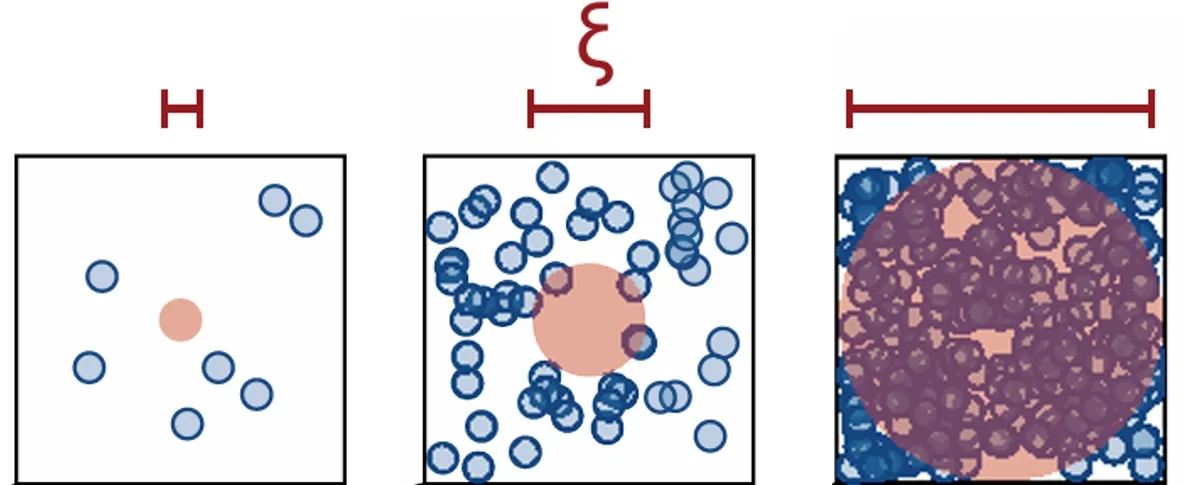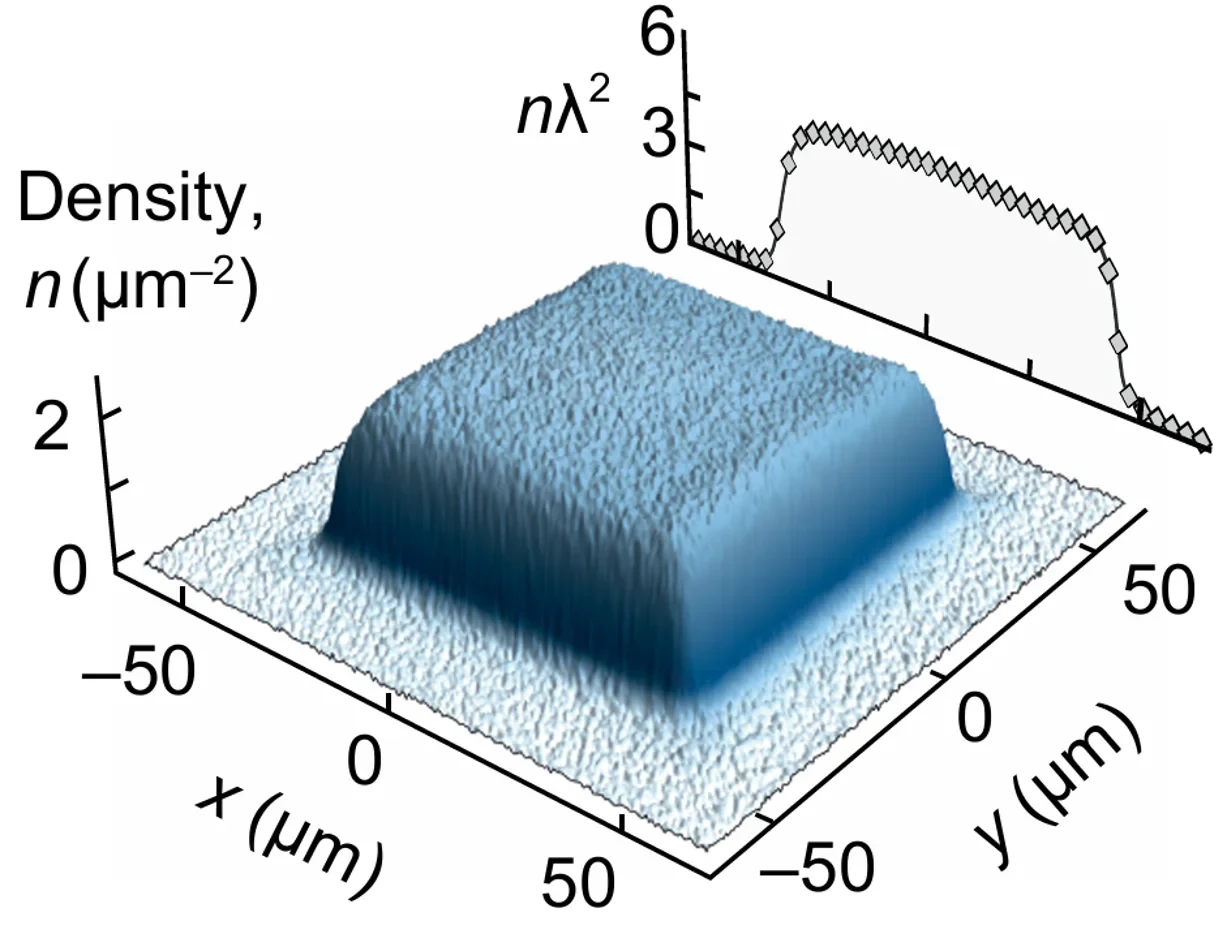
The team of researchers from the University of Bonn, Heidelberg University, and the National Autonomous University of Mexico investigated the critical behavior of photons near the phase transition to a Bose-Einstein condensate. This critical behavior, in which thermodynamic quantities diverge near phase transitions, had never before been observed in photon gases. To provide experimental evidence, we measured spatial correlations in a nearly interaction-free 2D photon gas in thermal regime close to condensation. From this, we determined the critical exponent, a quantity that describes how sensitively the extent of these correlations responds to temperature changes at the phase transition.
The photon gas was generated in an optical microresonator filled with a dye solution. Through absorption and emission processes that occur when photons come into contact with the dye molecules, the photons effectively cooled down (they “thermalized”) until the quantum phase transition to condensation began. One of the resonator mirrors had previously been patterned in the nanometer range using laser lithography to create a box-shaped potential—that is, a trap for the photons. The angular distribution of the emitted light was then measured with a camera, and the spatial correlations were determined.
This experiment demonstrated for the first time that photon gases constitute a distinct class of physical systems in nature; near a phase transition, the correlation length diverges with its own exponent. This research result fills an important gap in the physics of phase transitions and could open up new avenues for basic research on systems far from thermal equilibrium, as well as for future optical and technological applications.
The team consists of researchers from the Institute of Applied Physics at the University of Bonn (Leon Kleebank, Frank Vewinger, Martin Weitz), the Kirchhoff Institute of Physics at the University of Heidelberg (Julian Schmitt), and the Institute of Physics at the National Autonomous University of Mexico (Arturo Camacho-Guardian, Victor Romero-Rochín, Rosario Paredes).