
Newskollektion
QRM Images
View
Excitation Scheme
View
Rudolf-Kaiser-Prize
View

BoxImage
View
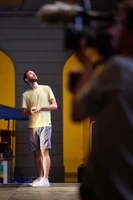
Andreas Redmann @ Science Slam
View
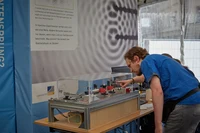
Steffi (or rather her finger) explaining the experiment
View
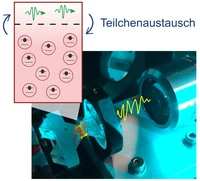
Experimental setup and origin of the fluctuations
View at the experiment: The photons are trapped between two mirrors, and interact with the dye molecules, visible by the orange fluorescence. From the statistics of the outcoupled light we can determine the fluctuations. The fluctuations result from the interconversion of photons and excited dye molecules and vice versa (Inset).
View

Photon gas in a box
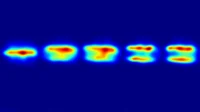
The data show the spatial distribution of photons in a box, for a photon number below the citical photon number for condensation.
View
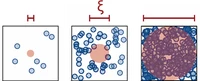
Correlations in a photon gas
Idea of the experiment: When increasing the number of photons (blue circles) the correlation length also increases (red circle). Near the critical point the correlation length diverges and gets larger than the system size. The photons then behave like a single "superphoton".
View

Dr. Kevin Peters
View

Wissenschaftspreis 2024
View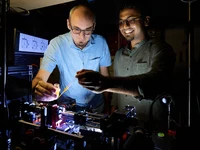

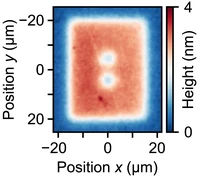
Double Well
A double well potential for photons: Photons can poulate either the symmetric (low energy) state or the antisymmetric, high energy state of the double well.
View
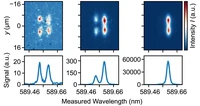
Population
As expect for bosons, the population in the symmetric and antisymmetric state favours the ground state for large occupation, even as the splitting is smaller than thermal energy.
View